

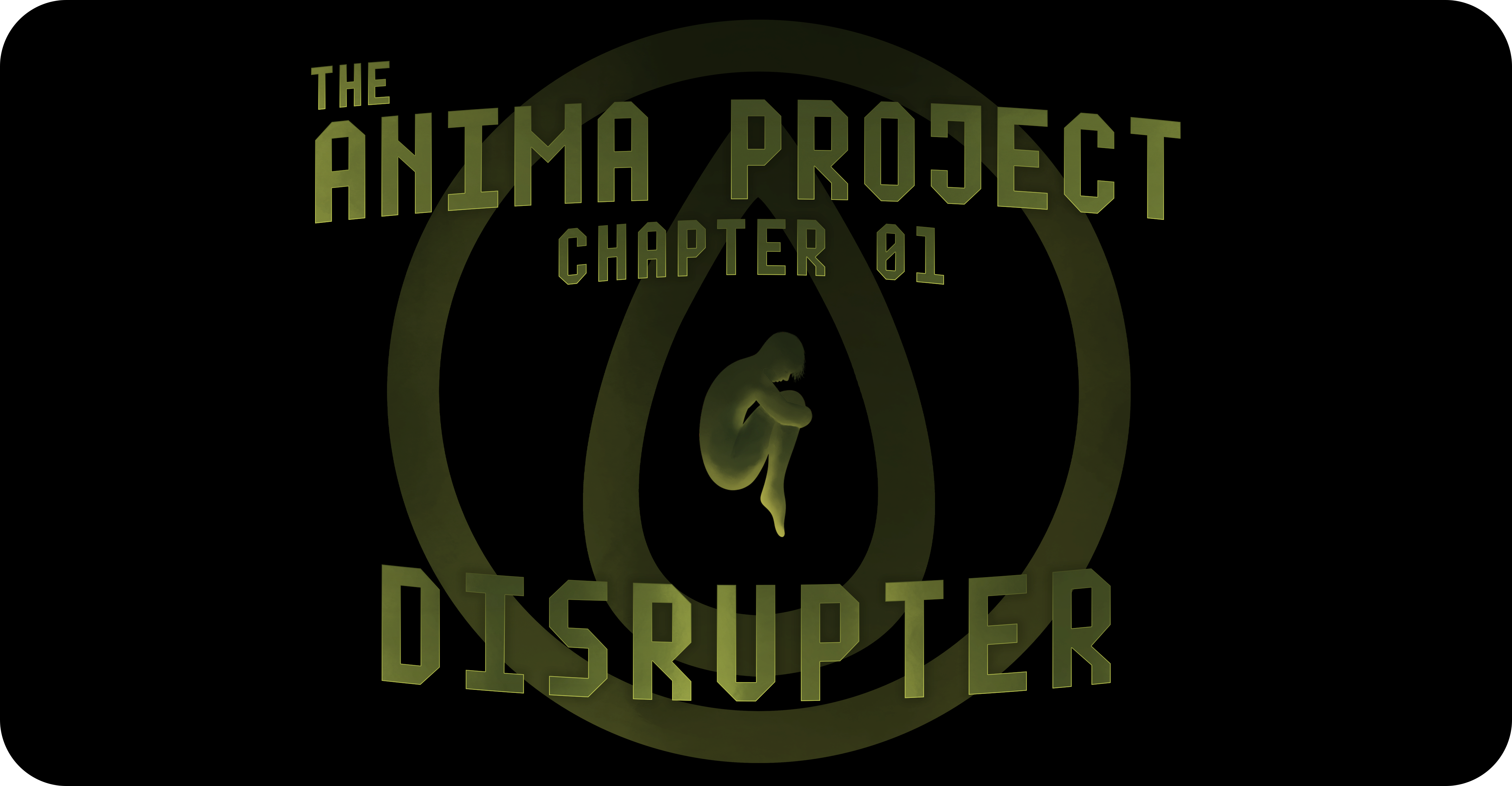
DISRUPTER
EPISODE 01 | SCENE 01

RESURRECTION WAS EASY. THE TRUTH IS NOT.
Dr. Renegade has done the impossible—he’s unlocked the door to eternal life. With a simple DNA sample and a brain chip transfer, anyone can be resurrected: their mind, their body, their very essence—preserved forever. But there’s one problem: his closest partner in the Anima Project claims it’s all a lie. If that’s true, what has he actually created? What if the dead aren’t returning? What if something else is taking their place? What if Renegade hasn’t conquered death at all…but invited it in? As secrets unravel, two men are thrust into a desperate search for answers, uncovering a deception more terrifying than they ever imagined.
DISCOVER THE TRUTH. BEGIN READING NOW.
YEAR 307
Blood swells on Renegade’s finger. The familiar sting already begins to fade. He stands locked inside the steel box, submitting to yet another identity check despite the hundreds of samples the facility keeps on file. He doesn’t care. Not today. Blood is the least of his concerns.
One leg trembles with restless tension while the android behind the glass watches in perfect stillness. Sweat cuts down his face and settles in his beard. His finger stays pinned to the scanner, waiting for the green flash. His gray eyes rake the immaculate walls for something—anything—to hold their focus, but the surface offers no imperfections.
The scanner finally blinks neon green, and the doors open with a low mechanical sigh. Renegade steps forward, but the android’s metallic voice halts him. “Cotton ball, sir?” it asks through the intercom. A steel arm dips into a jar of white fluff, retrieves a single ball, and deposits it into a drawer. A panel slides open on Renegade’s side, revealing the cotton ball. He presses it to the bleeding finger, saying nothing. He gives the android a short nod before stepping into the lobby.
The space feels more like a waiting room than an entry hall. Metal chairs line the back wall beneath humming fluorescent lights. The walls are blindingly white. Another glass partition separates him from the android’s cramped office. Renegade paces the perimeter a dozen times before stopping. “I’m here to see my son,” he says.
“Understood, Dr. Renegade. We know you are here to see your biological connection, August.”
“Now, android.”
“You could call me Android. Or C-2-1-4.” The machine points to the serial number on its chest. Renegade’s jaw tightens. “Again, we are aware of your request. Please wait while we review his file.”
Renegade’s foot taps against the floor. His gaze drifts upward to the silver lettering above the glass: BREED 000. He stares at the sign, unblinking, before sinking into a chair by the corner. Time drags until the main doors slide open and a man in a lab coat enters. Renegade rises at once. Both men are sharp-featured and immaculate, but only one bears concern in his eyes.
“Dr. Renegade,” the man greets coolly.
Renegade doesn’t respond. When the man extends a hand, he ignores it. Together they move down the long corridor, their steps echoing off the white walls. The lab coat flares behind the other man as he leads the way around corners lined with rooms. Renegade glimpses boys behind glass, all wearing the same silver uniforms, all staring back with empty faces. But he knows that hollowness hides something else.
A chill creeps up his spine, raising the hair on his arms. The silence of the corridor gnaws at him, broken only by the faint electronic pulse that grows louder as they near the end. The rhythmic beeping becomes distinct now, sharp and sterile. His heartbeat quickens. When they enter the final room, Renegade freezes. A boy—no older than five—is strapped to a reclining chair. His small limbs are bound to its synthetic leather, wires running from his body into machines suspended above. The sight drains the strength from Renegade’s legs. The boy looks trapped in a web of cables, one of them snaking into his mouth.
Tears spring to Renegade’s eyes. “Auggie,” he whispers, barely audible though he hopes his son can hear him; he is not sure Auggie can hear anything at all. He turns on the man in the white coat. “This is all you can do? Hook him up to wires?”
“There is nothing else we can do,” the man replies. “At present.”
“He’s dying.”
“All men die,” the man answers, voice clinical. Renegade pins him with a stare, but the man keeps his gaze on the boy. “Unstrap him,” Renegade demands.
“Then he certainly will die,” the man says, finally meeting his eyes.
“You heard me.”
“You are not authorized to make that call.”
“I said UNSTRAP HIM.” Renegade’s shout fills the room. The man folds his hands behind his back, unnervingly calm. Renegade grits his teeth and scans the room; a few white-uniformed workers watch, silent and impassive. Helplessness presses down on him like a hand.
“It’s the weekend,” Renegade says. “I have the right to take my son home on the weekend.”
“You have permission to oversee your biological connection during that time,” the man corrects, “but I warn you, the boy will die. The moment he is unhooked, his life rests in your hands.”
“Safer than yours,” Renegade spits. A tiny grin—more like a sneer—flickers across the man’s face, and he nods to a colleague. “Unhook the boy.” The colleague hesitates, then moves to the wall terminal. His fingers fly over the digital keyboard and, with a final tap, the wires begin to unlatch. Straps unwind and retract. The tube that fed into the boy’s mouth withdraws into the ceiling with the rest of the tangle.
Left alone on the chair, the boy looks stripped of everything that made him alive to the machines. Though he wears the same silver uniform as the others, he seems exposed and small. Renegade studies him; to some he might appear asleep, but to Renegade he looks dead. He crosses to Auggie, brushes his hair, murmurs, “I’m here, I’m here,” and lifts him into his arms.
Renegade moves for the door, but the man steps into his path. “Whether the boy lives or dies is of no great importance to us,” the man says. “He was better off here. Now you leave him to your own devices.”
“Quite right,” Renegade says, sure and hard. They measure each other once more, then the man steps aside. Renegade runs down the silent corridor and bursts into the waiting room.
The android behind the glass stands idle until Renegade bursts into the room with Auggie in his arms. Its sensors flare to life as it registers motion. When Renegade passes the partition and reaches for the steel doors, the android’s voice rings out, sharp and metallic. “Ah, ah, ah. You know the procedure.”
Renegade hesitates, then presses his finger to the scanner beside the glass. A green flash confirms his identity. He takes Auggie’s small hand and places it next. Another flare of green. The doors slide open with a hiss.
“Cotton balls, sirs?” the android calls, but Renegade is already gone, vanishing through the threshold with his son.
Outside, the world hits him like a wave. The air is thick with humidity and the stench of rain on steel. Neon signs sputter against the wet night, throwing fractured reflections across puddles and slick pavement. Bass-heavy music pulses from unseen speakers. Women in silhouette lean in doorways, their gestures hollow and practiced. Renegade ignores everything. He rounds a corner, clutching Auggie close, until a black vehicle comes into view beneath a single lamppost. Sleek and curved, it gleams like oil.
A flick of his hand opens the door. He slips inside, lowering himself into the deep leather seat as the canopy seals them in. “Anima Corp,” he says. The car hums to life, rises soundlessly, and glides down the empty road.
Rain streams across the windows, smearing the city into streaks of color and light. Renegade doesn’t look out. His gaze stays fixed on the boy in his lap. Auggie’s breathing is shallow, his body still. A tear slides off Renegade’s face and lands on his son’s forehead. More follow, unbidden, glinting in the dim light as he holds the boy tighter.
The ruins of the outer city fade behind them. The skyline shifts from rust and grime to glass and pulse-lit towers. Cracked streets become mirrored avenues. Above it all rises the dark monolith of Anima Corp. The name burns down its facade in towering letters, casting violet light across the air. The building dominates the horizon, the heart of the city’s mechanical rhythm.
The car descends into the depths of the structure, swallowed by a tunnel of darkness before bursting into a radiant atrium below. It hovers over its marked platform, then lands softly. The door opens.
Renegade steps out, shoes striking the polished floor with a sharp cadence. He strides toward the main entrance, his grip on Auggie firm. The boy’s skin has lost nearly all color; his limbs hang loose.
“Android!” Renegade shouts.
A sleek machine glides forward on wheels, its body streamlined and bright—an obvious upgrade from the one at BREED 000. Without hesitation, Renegade transfers Auggie into its arms. “Go,” he says, breath ragged. “Take him to the extraction room.”
The android rolls beside him at first. “Go!” Renegade roars. “Don’t wait for me!”
At the command, the robot accelerates, vanishing around the corner in a flash of chrome. Left alone in the vast lobby, Renegade bends forward, gasping for air. Then, with renewed urgency, he takes off again, moving deeper into the complex until the light gives way to the shadows of the underground levels.
The ceilings on this level hang low, pressing the space into a confined, sterile hush. Chrome panels line the walls, reflecting the dim, antiseptic light. The floor gleams with the smell of wax and chemical purity.
Renegade strides down the corridor, passing window after window into sterile laboratories where faint movements flicker behind glass. He doesn’t stop. His focus stays on the final door at the end of the hall. It opens into darkness. No windows connect this room to the others; only a single pane of one-way glass looks inward to an adjoining chamber that at first appears empty.
Renegade enters and pauses, his breath catching in his chest. The room beyond seems hollow and still, its white walls glowing faintly under the dim light. Then he sees the shape on the floor. A small body. Auggie.
He rushes to the control panel and slams a button. Instantly, the experimental chamber floods with harsh light. The walls split open as spider-like mechanical arms unfurl from their hidden recesses, more descending from the ceiling in perfect synchronization. They seize the boy without hesitation. His clothing rips away in shreds, and the machines begin their probing with mechanical precision, testing and scanning, indifferent to pain.
A surge of horror cuts through Renegade. He hurls himself at the controls, trying to stop it, but the sequence continues unchecked. The machines ignore him as they dismantle and examine the child he tried to save. His palms slick with sweat, Renegade grips the edge of the console. The room tilts. His vision folds into a haze of flashing light and whirring sound. Then the strength drains from his body. He collapses, and darkness closes over him like a sealed shroud.

A faint, high-pitched tone seeps into Renegade’s mind, dragging him back. The dim glow of the canister lights above shimmers into focus. He blinks, disoriented, then turns his head slightly. He’s still in the control room. When he tries to sit up, a wave of pain shudders through his skull, as if the inside of his head were vibrating. His hand reaches instinctively to the back of it. Warmth greets his fingers. He brings them before his eyes. Blood.
He can’t tell whether the ringing comes from the wound or the machines. The sound merges with the hum of the room. Using the counter for support, Renegade hauls himself upright, his breath uneven. He closes his eyes to steady the spinning world. Seconds stretch into a minute before he dares to open them again. The room sharpens, the haze clears, and the blinking red light on the control board takes form—steady now, pulsing in slow rhythm. The words beside it read: system fault.
Something breaks loose inside him. His gaze shoots past the console, up through the glass window. The lab beyond lies silent and stripped of movement. Only one thing rests in its center. A small, still body. Auggie.
Renegade gasps, the sound raw and animal. He lurches toward the door, grasping the cold handle. It resists before giving way with a mechanical groan. He stumbles inside, collapsing beside his son. The air leaves him in a shuddering breath. Tears gather fast, spilling before he can stop them. His hands shake violently as he tries to stir the boy, whispering his name through clenched teeth. But the truth settles heavy in his chest—Auggie is gone.
He gathers the small body into his arms, holding him close as if warmth could return through touch alone. His fingers trace the smooth curve of the child’s cheek, remembering how it once glowed with life. Tears fall freely now, splashing against the boy’s pale skin. His cries build, rising until the sound becomes unbearable, echoing off the chrome and glass, returning to him like a mockery of grief.
Renegade clutches his son tighter, drawing him in as though he could hide him from death itself. He would trade anything for one more breath from that small chest—but the room remains silent, and the boy remains still. The man bends over the still form, whispering fragments of plea to come back. If only that were possible…
